The Second Kind of Gratitude
The Second Kind of Gratitude
Fourth in the series on the five heart qualities: Trust, Openness, Love, Gratitude, Deep Respect.
The Heart Initiation focusing on Gratitude will be September 4th.
There are two kinds of gratitude.
The first kind of gratitude is obvious to all reading this. It comes when something good happens to us, or when something bad is avoided, survived, or finally behind us.
The second is very different and not nearly as well known, though it should be. This kind of gratitude needs no good news at all. It is available in every situation, sunny or rainy, hot or cold.
I call it unconditional gratitude.
But let us begin in San Francisco, with my man Tom Lipscomb, the Café International, and a little piece of paper.
Awe on one side. Terror on the other.
If this were 1992 and you were walking down Haight Street from the Upper Haight, in San Francisco’s famous hippie district, you would see the stores with their tie-dye shirts, bongs, pipes, marijuana insignia, esoteric bookshops, crystal shops, and latter-day flower children sitting on the sidewalk begging for coins or selling “kind weed.”
Keep walking, and the vibe would change within a few blocks.
Once you pass Divisadero, the neighborhood becomes another animal altogether. The air starts to feel cooler. The hippie vibe of the Upper Haight gives way to the inner-city vibe of the Lower Haight. The people you meet below Divisadero have an edge. Flower dresses become leather jackets. The smell of patchouli gives way to cigarette stink. The housing projects loom large, and the tough people hanging around look formidable.
Keep walking, and just before you get to Fillmore Street, the line separating edgy bohemia from pure chaos, you come upon the glass doors of the Café International.
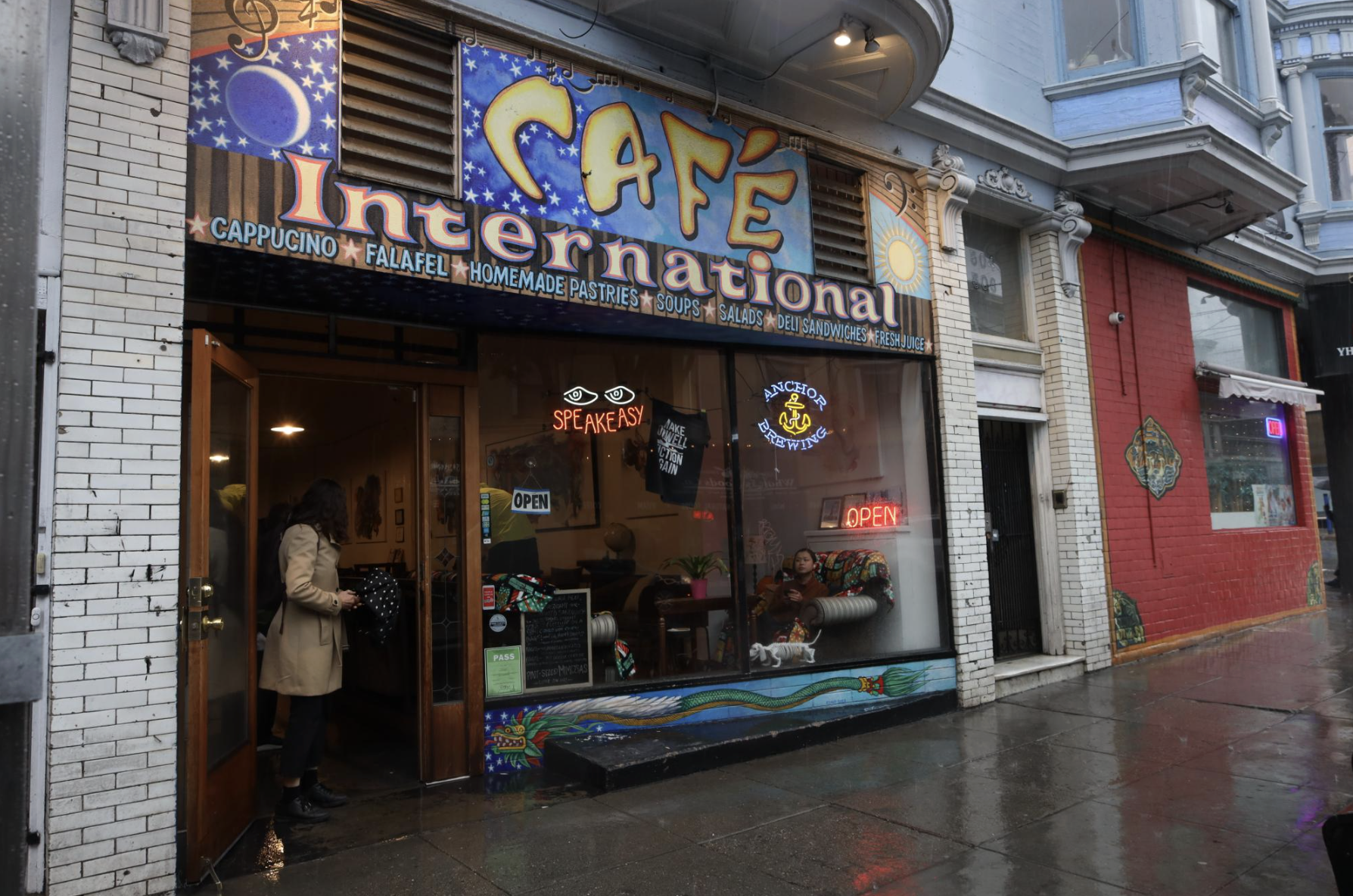
Walk in, look to the right, and you will see a table in the corner. Sitting at that table will be a man you cannot ignore.
You must do a double take.
What will you notice? His pile of sketchbooks? His mohawk? His sharp blue eagle eyes? His beak-like nose? His rock-hard body? Maybe you notice the people gathered around him, as if bowing before a guru, paying their respects to a dignitary or seeking solace from a priest.
Maybe you smell the clove cigarettes he is sure to be smoking.
You have just encountered Tom Lipscomb.
Now look at the table just behind him. Notice a young man bent over a journal, talking to himself as he writes. He is a twenty-seven-year-old version of me, Alan Steinborn.
Every morning, weekends included, I was at that table, diving deep into thoughts, journal writing, poetry, reading, and sometimes connecting with the other freaks of the cafe.
Most everybody came and went, but Tom and I were as regular as regular could be. Still, as often as our eyes met, we had never spoken, or even nodded a hello. But make no mistake, I had observed this big man in minute detail.
On this particular day, I had just put the finishing touches on a poem I was proud of. My friend Jacque came to visit. I asked her if I could read it to her. Like most of my friends, Jacque had no time for my poetry. She gave me the usual line: I’m too busy.
So we said our goodbyes, and I went back to writing. Then I heard a baritone voice booming from the corner:
I’ll read it.
I looked up.
I will read your poem.
I didn’t wait for him to ask a third time. I brought it over straight away.
He read it slowly, carefully. When he finished, there was a pause as I waited for the verdict.
He looked into me with those piercing eyes and said: It sounds like you’re trying to find your voice.
Then silence.
And then: There is a thrill that comes with finding your voice. Don’t fall in love with that thrill.
After that moment, we were tight friends. Visiting Tom’s table became a daily ritual. I would go over to him and he would boom AL BABY, and kiss my forehead. Then we would hang out for half an hour or so while he smoked his clove cigarettes or sketched some pretty girl across the room, all the while talking to me.
After getting to know me for a couple of weeks, he took a little square piece of paper from a sketchbook, wrote a word on it, and said:
Al baby, do you know what you are?
What am I, Tom?
He handed me the paper and told me to look at it.
There was one word: AWE.
Al Baby, you are an awe junkie.
Then he grabbed the paper again, wrote something on the back, and said,
Beware of the other side.
I turned it over.
Written there was the word TERROR.
The basic meaning: you don’t reach true awe without the terror of facing the limits of your identity. Not the watered-down “awesome,” but awe that blows the mind wide open and forces you to remake your life.
As I sat with my coffee, thirty-five years after this conversation, it hit me that what Tom was describing was a form of gratitude we all know. This is conditional gratitude. Something happens and I am awestruck. Something happens and I am terrified. Perfect.
Conditional gratitude is the gratitude you feel because things are not their opposite. The condition is good, and so you are grateful.
The first gratitude: Conditional Gratitude
I’ve thought a lot about that square piece of paper over the years. It calls to mind one of the last sentences of The Count of Monte Cristo. You have to get through more than a thousand pages to reach it, but it’s one of the best in the book:
“There is neither happiness nor misery in the world; there is only the comparison of one state with another, nothing more. He who has felt the deepest grief is best able to experience supreme happiness.”
To feel tremendous joy, you have to know the depths of sorrow. And in a way, that’s what Tom was saying to me: to experience tremendous awe, you’ve got to be willing to experience tremendous terror.
This is the gift of the negative. It illuminates the positive. It gives life its dynamism, and without that, life has no zest. It’s as if the journey never happened.
An empty stomach makes food delicious. Fatigue makes you sleep deeply. All ecstasy comes as relief from some kind of stress.
Take enlightenment. What is it? Waking up to your true nature. But what makes that awakening so indelible, so dramatic, so blissful, so liberating, so important?
Isn’t it all the pain and suffering that came before it: the ignorance, the struggling, the fear, sadness, anger, the loneliness?
Think about loneliness. You walk around feeling alone and misunderstood in the midst of all these other humans. All these humans and no one to call. No one to connect with. And then all of a sudden one shows up and connects with you as you are. There is love. There is a deep joy.
But where does this joy come from? The power of the connection comes from the struggle of disconnectedness. No loneliness, no bliss of connection.
So the seed of conditional gratitude comes in its opposite.
But here is the problem with conditional gratitude: we don’t want the opposite condition, even though it is clearly needed. We don’t want the terror, we just want the awe. We don’t want the loneliness, we just want the joy of love. We don’t want the fear and the pain, we just want the enlightenment. If life is a pendulum swinging from positive to negative, we want it to swing to one side and stay there. Alas, it doesn’t work that way.
Conditional gratitude teaches us that this is as it should be!
Eventually, we give thanks to relationships that ended or never happened, the failures that led to greater successes, the sadness that opened our hearts. This is the beauty of conditional gratitude.
When we can fully appreciate the power the negative has had in our lives, we appreciate the pain that brought us to a new level of peace and love and truth: the burnout that forced better decisions, the cancer that showed us what really matters, the death of a loved one that brought a family together, or at least tore off the bandage of fake love.
As great as conditional gratitude is, it still requires conditions. You are grateful to walk free, but could you have been grateful inside the jail? Not for any reason. Just grateful.
That is the second kind of gratitude.
The second gratitude: Unconditional Gratitude
Unconditional gratitude requires no situation, positive or negative. Only the fact that you exist.
Consider a prisoner. Conditional gratitude is that prisoner released, hugging his mother for the first time in years.
Unconditional gratitude is the same prisoner still inside: the meditation he is learning in his cell, the way he helps an old inmate through a hard night. Nothing about his situation has changed. He is supplying the one thing the situation cannot give him: his own response.
No matter what is happening, the conditions give you nothing, and you supply the response anyway. That is the freedom. No one I’ve read has put it better than Gregory David Roberts. In his novel Shantaram, he writes:
“It took me a long time and most of the world to learn what I know about love and fate and the choices we make, but the heart of it came to me in an instant, while I was chained to a wall and being tortured. I realised, somehow, through the screaming of my mind, that even in that shackled, bloody helplessness, I was still free: free to hate the men who were torturing me, or to forgive them. It doesn’t sound like much, I know. But in the flinch and bite of the chain, when it’s all you’ve got, that freedom is an universe of possibility. And the choice you make between hating and forgiving, can become the story of your life.”
— Gregory David Roberts, Shantaram
Roberts is speaking of forgiveness, but it is the same form as unconditional gratitude. When the conditions give you no reason, you can still choose what you bring to them. Gratitude is that choice, turned toward life itself.
Unconditional gratitude follows the understanding that the world is full of magic things, patiently waiting for our senses to awaken. For us to learn to be here now, as they say.
When your awareness rests, there is the possibility for gratitude for little things, and that’s what makes it so wonderful. A crack in the sidewalk. The air going in and out as you sit in a traffic jam. The shadow on someone’s face. A gesture between a mom and a child.
There’s so much beauty everywhere that going away becomes silly. Why bother when paradise is right here?
The key to unconditional gratitude is to become sensitive to what’s going on now. And the key to that is to stop reacting to thoughts and feelings that keep your focus narrow and distracted. To learn how to direct your focus moment to moment.
Awareness is the tool, because the amount of beautiful things in your life depends on the amount you notice. If you don’t notice things, it’s as if they’re not there.
So why call it unconditional, when it seems to ask for so much: the trust to be here, the openness not to react to the mental impulses that pull us into a kind of hypnosis, the slowing of action and reaction.
Because unconditional gratitude takes no effort to generate. We only need to release the habits of thought and inattention that, though they seem ingrained, are just habits. Our nature is already grateful for it all.
There is a line often attributed to Rumi: your task is not to seek love, but to seek the barriers within yourself that you have built against it. The same holds for gratitude.
This is how I experience unconditional gratitude. I am so caught up by the small and the beautiful that I’ve lost my appetite for working to get the big and beautiful. I don’t want to get on a plane. I don’t care about the drama. I need no crazy intensive or retreat to love what is already here.
I am so focused on unconditional gratitude that when there was a once-in-a-lifetime solar eclipse a couple of days ago, I didn’t bother to look at it. I reflected. Why is this so? I’m not depressed, or on my deathbed. I have my senses, so why didn’t I walk out the door to see this celestial phenomenon? Because I didn’t care. I see miracles everywhere, so why go outside for the big wow, when the big wow is me getting excited by light pouring through the curtains in my room, looking at the little composition of light dots. This is so cool. Why would I need more when I’m getting fed on such things?
Unconditional gratitude is my zip code. It is where I live, wherever I live. Why? Because my eyes have opened, at least that much.
The paper I would hand back to Tom
If I could go back to the Café International today, in 2026, and sit down with my old friend Tom after all the awe and terror I have lived through, I would hand him a new piece of paper.
On one side it would say:
This is amazing.
And I feel certain he would let out that booming Tyrannosaurus rex laugh when he turned it over and read:
This is also amazing.