Attention.
Creates.
Experience.
A long-form composition, free of musical cliché, that illuminates how visitors perceive the moment.
In the space of this experience, visitors discover how their attention creates the moment as much as anything 'external.'


The Artistic Core
A work that shows visitors not where to pay attention, but how.
All art guides attention. Music is no different. When listeners hear music, their attention is guided. A melody rises and they follow it. A rhythm builds and their body responds. A chord resolves and they feel satisfaction. This is how music works — it gives attention somewhere to go, and attention follows.
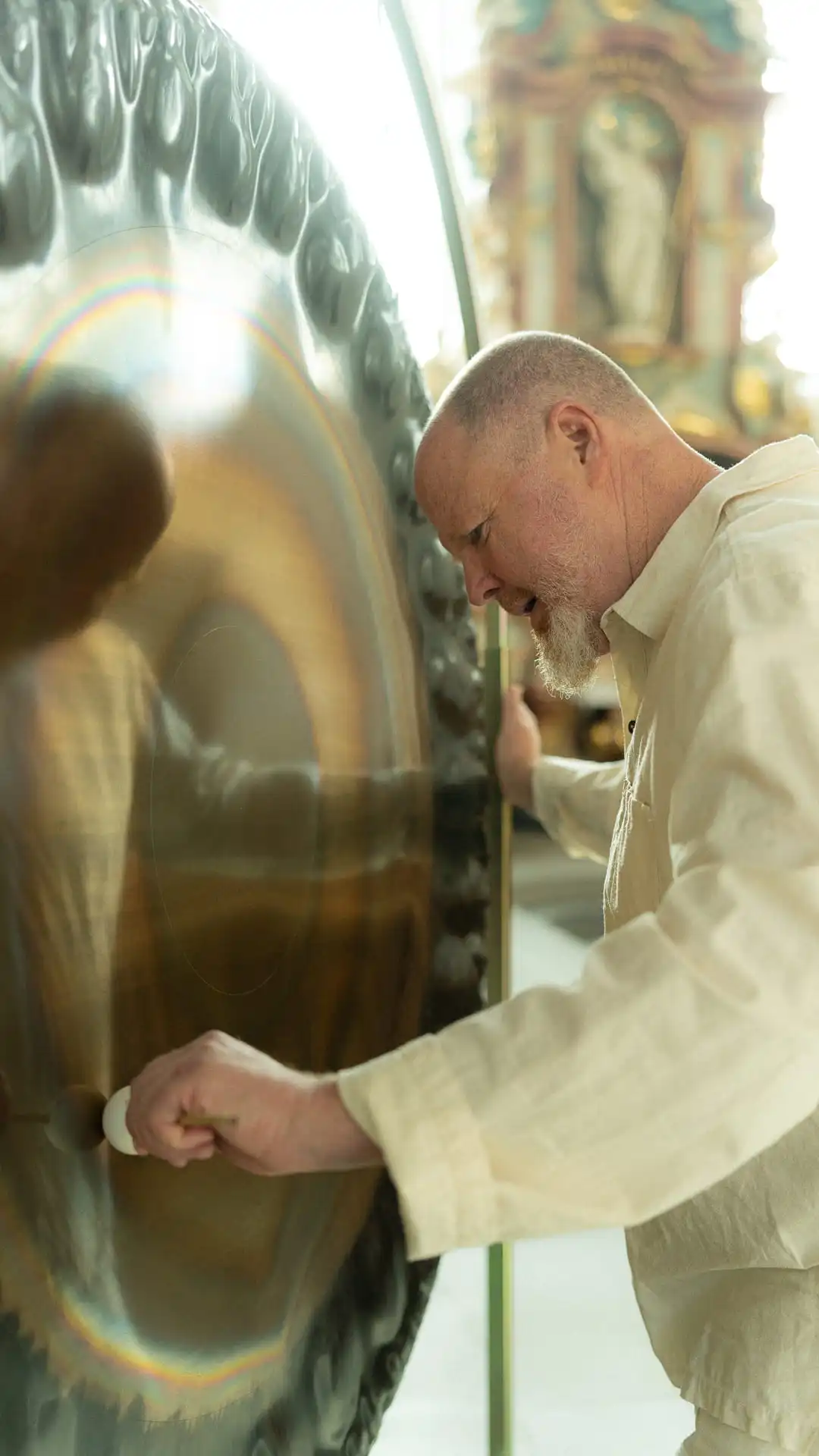
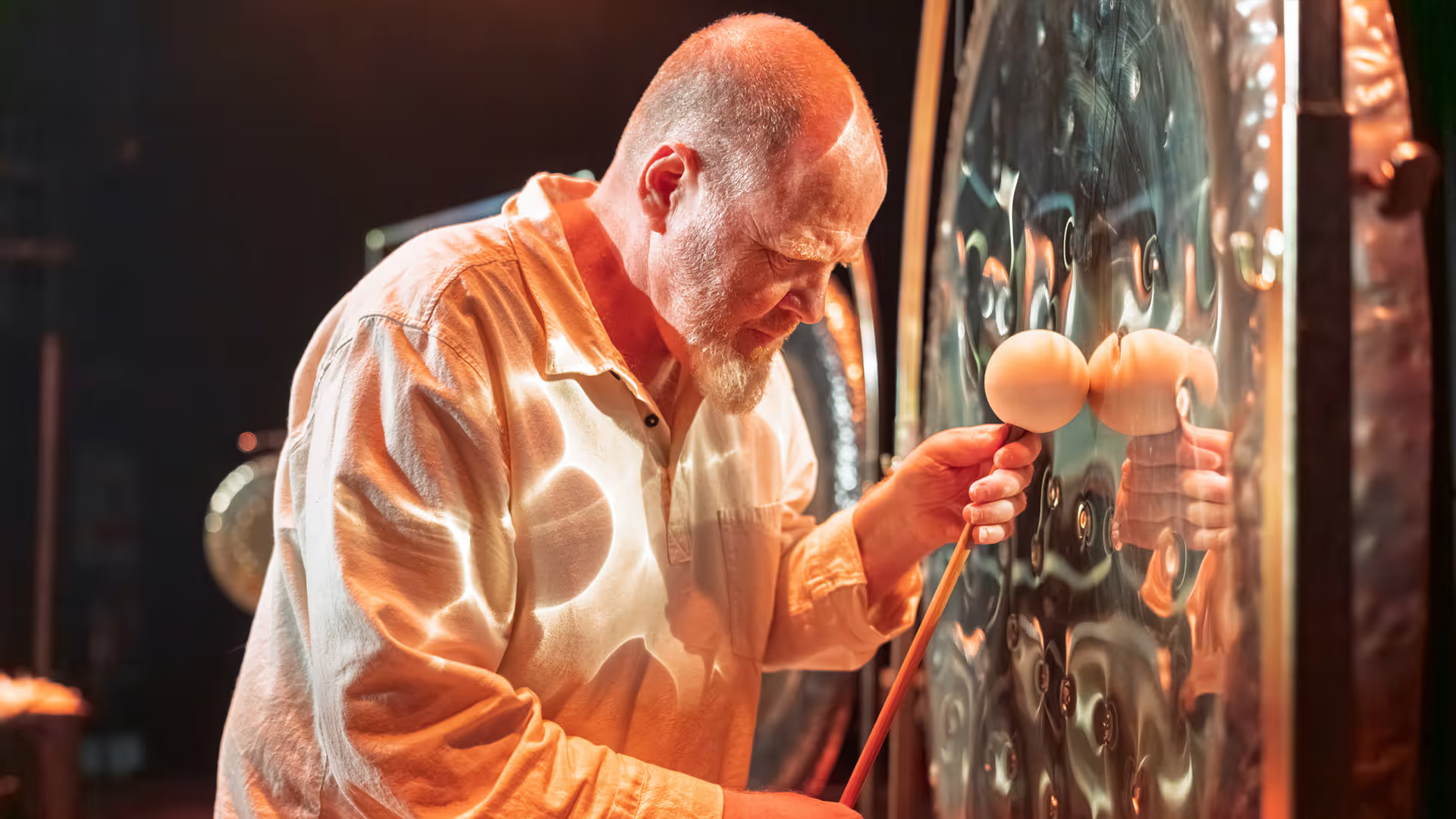
Alan Steinborn's gong-based work functions differently. It doesn't tell visitors where to pay attention. It guides them into an exploration of how they pay attention.
The gongs produce complex, layered sound that stretches outward in time. Unlike music, this sound is deliberately composed to avoid the familiar structures that normally guide attention. The tones and overtones are beautiful — but they extend beyond what the mind can easily follow.
The visitor wants to be there, but their usual way of following along doesn't work.
The sound is seductive and beautiful, but it goes on without a conflict, without a climax and without a resolution. This creates a space in which the listener begins to flow with the sound rather than listening to it.
It slows down their minds and they begin to notice the quality of their own attention. How it moves. How it rests. How it goes away and returns. How it constructs the experience, moment to moment.
The Museum as Collaborator
The museum is central to this work.
Not only as an architectural container, but as a place already devoted to attention. Museums hold objects, but they also hold time. They create conditions in which perception can slow, dwell, and deepen.
This work resonates most strongly with institutions already exploring how experience can move beyond interpretation into perception; how time-based, participatory practices can exist alongside object-based exhibitions; and how sound, stillness, and attention may quietly reshape the experience of space.
The acoustics, volume, surfaces, and programming rhythm of each institution form the underlying structure of the work. The gongs respond to these conditions rather than overriding them. Sound unfolds in dialogue with architecture, artworks, and the presence of visitors.
The session is not separate from the exhibition. It works in consort.
Artworks are encountered differently through sound. Sound is shaped by the artworks in return.
Each collaboration emerges through dialogue — guided by the mission of the institution, the character of the space, its acoustics, the audience, and the moment in which it takes place.
A museum does not host this work. It shapes it.
Artist Statement: The Search for the Ultimate Echo
In the spring of 1992, I abandoned my family in a park in San Francisco and ran back to my apartment to get my saxophone. I had just heard something in a tunnel that I needed to answer. I didn't know it then, but that moment defined the next thirty years of my life.
It also illuminated a way of relating to reality I have used since before I can remember.
I have always needed to hear myself out loud in order to understand the world. Sound is not my medium. It is my way of knowing.
Thus, echoes have always been my currency as an artist. My creative quest is to create an echo which has no cause, no source. The ultimate echo, if you will.
.webp)
About the Artist
Alan Steinborn did not arrive at the gongs through a conventional path. From early on, the normal course — conventional thinking, institutional learning, following authority — was simply not available to him.
Necessity drove him inward. He had to learn to become his own authority, to focus without being told how, to ask better questions, to think like a river.
In the process, he discovered something that would define his artistic life: sensitivity as a discipline. The capacity to feel what is actually happening in a room, in a sound, in a moment, and to metabolize that experience as it unfolds. From the bottom up. From the inside out.
His life has been a challenge. The challenge of feeling too much. But he doesn't complain. He likes to say: The more you experience, the more there is to experience.
For the past decade, that path has led exclusively to the gongs. Alan is based in Zürich, Switzerland, where he operates Das Gongbad. He has presented site-responsive works in museums, churches, and institutional contexts internationally, including the Fondation Beyeler. Across all of them, the practice remains the same: shaping conditions in which sound, space, and attention become a unified field.