The Best Love There Is - A Complete Guide
The Freelance Philosopher's Guide to a Love not dependent on good weather, good people, or good thoughts.
Author's note: this is a BIG topic. If you take it as such, it can change your life. So the text is rich and full. For those who want the gist, I have created a short version near the end, and a one-page version after that. Scroll down to whichever suits you.
Most of us know how it feels to fall in love. Life pulsates in a different way. Colors brighten. Faces assume a beauty we hadn't noticed before. Life becomes musical.
In our society, this way of falling in love is the predominant way. It is confirmed in the movies we consume. The first kiss, the longing looks, the endless drama.
Another current popular version of love is the "being in love with my life" version. We follow what appeals to us, and ghost what no longer works for us. We can call this kind of love the Instagram love. Those gorgeous sunsets off the coast of Bali. Those vistas from the alps. Those yoga retreats. You know what I am talking about. The "follow your heart" kind of love.
So it follows that we begin to assume this is what love is. What if I told you, you are barely scratching the surface of what love is, and suffering for it.
If love were the apples of an apple tree, this kind of romantic love, or this kind of personal bucket-list love, is a rotten apple that fell from the tree long ago, and you are bent over trying to find the best rotten apple while the ripe ones, the juiciest, tastiest, healthiest ones hang just above your head, there for the taking.
This rotten apple love is what it is to love the one person, the one friend, the one family, the good weather, the exotic island, and not the rest of life. We learn to love in pieces and preferences. But life does not come in pieces. Life is endless. And life is you.
Please note: I am not saying there is anything wrong with finding the love of your life, or loving your family, or living your best life. What I am saying is that when you love these things at the expense of everything that is not these things, you will suffer.
There is no problem with loving what you love and who you love. The problem is loving them in such a way that they are exclusive in your field of love. When you love nothing else. That is the problem.
I am here to talk to you about everything else, and how to love that — because all of it is who you are.
Life does even more than just include you. You are that! You are not standing outside of life. Whether you know it or not, you are already one with all the love that ever existed.
The problem is that you choose one situation, one love, and exclude the others, and by doing that you actually exclude love for all of it, including your love object of the moment, because love is not a special condition for a special moment or person. It is the glue that holds the whole thing together.
This article is an invitation. I wish to show you that it is possible to fall in love with the whole of life, starting with what is happening within you and around you at this very moment.
This is not the monk's path, who turns away from the world to find his peace. It is not renunciation. It is not a call to simplicity or minimalism or even good behavior. It is also not grasping for more and different experiences. It is saying yes to what is already here. It is a possibility for you to meet this same old same old life, as if for the first time.
That is the best love there is. A love not dependent on good weather, good people, or good thoughts.
Here is how I found it.
Prologue
How I first encountered unconditional love in front of a sleeping ex-girlfriend.
What follows is a personal story. If you prefer to go straight to the theory and the practices, skip to Part I.
It was February, 1991 or 92. I forget which. I was 27. I had just come out of my first so-called committed relationship. To say that I had come out of this relationship is not to give it its due. It wasn't coming out. It was a crash landing of a miserable flight.
We were "together" for three years. The only reason we managed for that long was because for most of that time, we lived in different cities. When she finally came to stay with me in San Francisco, it was clear within two weeks that it wasn't going to work.
I will spare you the dramatic details. In short, we split. She moved out of my little room and found herself a beautiful apartment just two blocks from Ocean Beach, top floor, looking out onto the water.
This breakup hit me hard. Not because of the loss of the relationship. My basic attitude there was relief. My unease was a growing sense that something was wrong with me. I mean, how was it that I participated in a relationship this ugly? And for so long!
This was a big realization. Up until that point, every problem I had was somebody else's fault. The government, the society, my upbringing, whatever.
For the first time ever, I was looking in the mirror. I didn't like what was looking back at me. For the first time in my life, I couldn't deny that the problem was with me. If things were to get better, it was up to me.
That was the bitter truth staring back at me from the mirror.
I started a period of soul searching. I consulted self-help books. I went to therapy, which didn't work for me. Then I found something called Codependents Anonymous (CoDA), like Alcoholics Anonymous, but for people whose particular addiction was needing other people to behave a certain way in order to feel okay.
Which is to say, almost all of us.
You don't consider yourself codependent?
Ask yourself: do you need people or situations to be a certain way for you to be ok? If yes, you have codependency. It is actually a normal condition.
I jumped in deep and went to CoDA meetings twice a week.
In these meetings, people would simply talk about what was going on in their lives. It was astounding, all the stories I heard.
I learned way more from listening to these stories than from talking. There were two groups of people in those meetings, according to my thinking: the victims and the hopefuls. The victims, for whom life was happening to them. The hopefuls, who acknowledged the same challenges but talked about steps taken, little wins and big wins. I learned from both the hopefuls and the victims. They were two different aspects of myself being dramatized for me at each meeting, giving me the clarity I so desperately needed.
After about three months of these meetings, something became clear to me that sounds obvious now but wasn't then. The ex-girlfriend and I were both innocent. Neither of us knew any better. We were both just doing what we thought was good and right, and it was all so human, with no bad parties involved. I was so relieved by this new understanding that I wanted to share the good news with her.
So I called her and asked if we could meet. I told her I had something important to share with her. She agreed: why don't you drive me home Friday after work? So we met Friday. We drove to the edge of the city.
We went up to her apartment, and she showed me the living room, which was two couches coming together in the corner of a room. That is where we installed ourselves. We started by talking about this and that. Just catching up. Then the moment arrived where I could say what I came there to say. At that moment, she did something typical of her. She lay down on the couch and promptly fell asleep.
There I was on that couch. The words on the edge of my lips. A sleeping ex-girlfriend in front of me. The whole visit had been so magnanimous in intention that I couldn't be angry. So I asked myself: well, what now?
On the other side of the living room was her roommate's bookshelf. I went to look. Pulpy dime-store stuff, mostly. Nothing of interest. But then there was a thin book with no writing on the spine. I pulled it out. It was called The Lazy Man's Guide to Enlightenment, by Thaddeus Golas. I had no spiritual framework at the time. Zero. I was looking good in my fancy suits, going to fancy sushi restaurants, imagining an upscale life and basically unhappy.
But this book. It somehow attracted me.
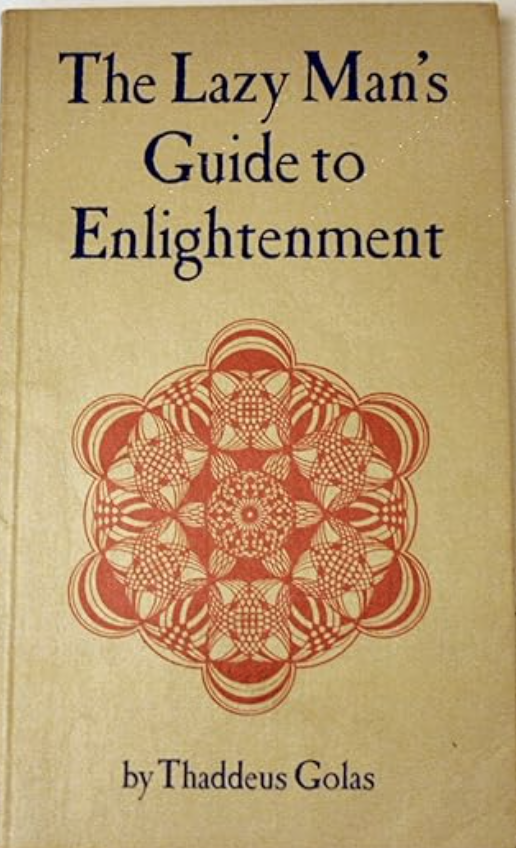
I started reading. It was astounding. I already knew everything Thaddeus was saying, but had never put any of it into words. I was reading something I already knew in my heart of hearts, and it felt like coming home.
Dots started connecting inside me. By the time the ex had awoken, I had read twenty-three pages and was a different person than when she fell asleep.
She woke up and immediately asked for the time. Seven forty-five. Oh, she said, I have a date in fifteen minutes. The bell rang. Oh, that's him! I said: no problem.
We went downstairs together and opened the front door. There he was, a handsome young man. I grabbed both of them by the hand and said: you guys have a great evening. Then I got in my car, drove to the Green Apple bookstore, and bought myself a copy of The Lazy Man's Guide to Enlightenment.
Many other important things happened that evening. I will save those for another time.
What you need to know is that with this book, I was on a new path. The path I was on is the path I am still on. It is the path of love. Not romantic love, but love which is the glue that holds this whole beautiful catastrophe we call life together.
What was in those twenty-three pages is, essentially, the subject of this article, and more importantly the path I have been walking ever since.
Part I
The first one to love is you.
The first one to love is you. The first place to love is here. The moment to love is now.
If self-love is going to start anywhere, it starts wherever you are.
But come on, says the skeptic. I have heard all this before. And it is true. The phrase, love yourself, is old and stale, like a piece of dried out bread.
Though the phrase "love yourself" is a commonplace cliché, it is still very true. There is nothing more urgent than the need to love one's self. The question that needs your attention is what does "self" mean?
What is this self that we are supposed to love? Here is how I define it. The self is not some static thing. It is not a single story you tell yourself. It is not even just your body. It is all the thoughts and feelings you experience within. That is yourself. All of it is you.
So it follows that to love yourself means to love the thoughts and feelings that are moving through you right now. All of them. Including the thoughts and feelings you would rather not claim. The fear. The pettiness. The jealousy, the boredom, the shame. I call these the stepchildren of your inner life, the ones you keep hoping will sit quietly in the back and not embarrass you.
To love yourself is to include all of it, including the uncomfortable, the negative, even the catastrophic within.
Thaddeus Golas put it perfectly. Being the ego of a human body, he said, is a little like being the Mayor of New York City. A vast population of sensations, emotions, and thoughts lives and acts in your name, almost all of it without your choosing.
Think about it. How many of the thoughts you think simply occur to you. And yet we trust these thoughts, and they are almost always wrong. You do not author your thoughts; they arrive. You do not approve your feelings; they just show up.
And this is the magic of the best love. This kind of love includes the unlovable and the unloving.
In Golas's words, it is the one action that contains its own opposite. It moves to include the unloving. It leaves nothing outside itself, which is exactly why it heals where positive thinking cannot. You are not trying to feel good about what is hard. You are simply stopping the war against it. Nothing is exiled, so nothing has to fester.
This is a relief. What it means is that you don't have to change your behavior first. You do not need a good attitude. You do not have to feel warm toward anything. You do not even have to know what it feels like to be loving. Golas says it plainly: if you are not sure how it feels to be loving, love yourself for not being sure.
You only have to include whatever you happen to be feeling or thinking. You just need to stay with it, as it is. There is no inner state that is outside this. Despair can be met. Anger can be met. Shame and lust can be met. Confusion can be met. The whole ridiculous dance of being a person can be met, exactly as it is.
This doesn't mean we don't fight the good fight, if that is what we want to do. Golas is emphatic about this, and so am I. No resistance here means no resistance in the mind. It does not mean putting up with bad behavior or rip-offs. You can be entirely at peace inside and still leave the room, still refuse the deal, still leave the wife or husband, the girlfriend or boyfriend. You can still say no. In fact the inner peace is what makes your decision clean, because it comes from a bigger yes within rather than from reaction. It is always all right to say no.
So what do you have to do to begin with this kind of love?
Nothing.
Nothing needs to change first. Not your diet, not your habits, not your phone, not your mood. What you are going through right now is already the material. Golas, who titled his book for the lazy man, said there is nothing you need to do first in order to be free. Life as it is can be loved, and when it gets loved, the changes that need to happen begin to happen on their own. Left unloved, it only hardens, no matter what you do to improve yourself. That is not a moral rule. It is simply how it works.
Which leaves one real question. How? How do you actually love what is here, especially when you don't, when the feeling is too big and the mind is too loud and "just love it" sounds like a cruel joke?
Or your life may not have any dramatic issues. Still, how can you awaken the unconditionally loving heart?
It is all about where and how you place your attention.
Part II
The Good, Better, and Best Tools of Expanded Love
Everything in Part I comes down to one practical question. How? How to love what we are not used to loving? I am not even talking about the experiences we find repulsive. I mean just everyday moments. How can we engage with these moments, and also the moments that challenge us to expand in love?
That is what this section is all about.
It turns out the engine of love is focus. Our focus is our forgotten superpower. We are going to remember it now, and develop it.
Why? Because a distracted mind is an unhappy mind. A focused mind is a happy one. Positive and negative thoughts are secondary. Pleasant, enjoyable experiences and unpleasant, uncomfortable, sad ones are secondary. You always have the power to choose where and how you pay attention, and that is all the power you need to expand in love.
Here are three tools. I call them good, better, and best. They are not ranked by how much they are worth, and they are not rungs you climb and leave behind. They are tools, the way a hammer and a saw are tools. You reach for the one the moment allows. I call them good, better, and best only because each is a little more direct, a little closer to the truth of what is actually here, than the last. When the best is out of reach, and it will be for most of us most of the time, you use the better. When the better is out of reach, you use the good. All three do the same job. Each one helps you expand in love.
The Good tool: intentional thought
The first tool is a thought you think on purpose.
For a moment, think about how you think. Most thoughts just occur to us. They arrive uninvited, and many of them are negative, and most of them are wrong, and yet we believe these thoughts without question, or, even worse, we identify with them.
The good tool is for those moments when the hypnosis of automatic thought is so thick that you can't see through it.
Think about what it is like to be lost in social media scrolling. No shame, just consider the mechanics of it. Getting lost in the imagery and the ideas and the relationships as we scroll down. This is a good outer metaphor for what happens inwardly all the time.
The power of the good tool is to take charge of the meaning-making machine and make some meanings that give you the space and power to pick up the better tool, directed focus.
Here is how the good tool works. It is very simple and very powerful. You simply insert a thought into the mix of your thinking.
These are some examples of thoughts I use many times a day:
This is what needs to be loved.
As it is.
Don't resist this.
What did you think it was that needed to be loved?
What can I learn from this? (This one is my new favorite. I have realized that to love is to learn. When we love, we learn. That is a great benefit of loving everything. We learn from everything.)
We use these phrases not to argue with what we think or feel, but to create a new thought, a new feeling, which opens a small gap in the automatic thought stream. The moment we have opened this gap, a new choice becomes possible.
That is the moment we employ the better tool.
The Better tool: directed focus
The thing about the mind is that it is always symbolic. A glass of water is not the actual glass of water. There are the words, either the squiggles on the screen, or the sounds coming out of your mouth: GLAAAAAAAASSSSS OF WAAAAAAAAAAAATERRRRRRRRR. The squiggles and the sounds are not the liquidy stuff you drink, and not the vessel you drink it from. This is a key piece of information. It is a key clue on how to expand your love.
The words I love you, as wonderful as they are, are indirect. Direct love is a function of awareness.
The question of where you are paying attention is the same question as what you are loving. When you place your attention on your thoughts more than on the physical reality you are in, you are loving your thoughts more than your here and now.
All that is needed to be freed from the prison of the mind and to love the here and now, which is where the true magic happens, is to direct your focus there. It is so simple, we miss it.
But once you learn how to direct your focus, your life is never the same. Thoughts simply don't have the power to disturb you any more. It no longer matters if the thoughts are beautiful or ugly, intelligent or stupid, because you know, by the very fact that you have the power to focus where you want, that these thoughts are not you and they don't actually matter. They are like the sound of passing cars. They come, they are there, they are gone. Just like that.
The ability to direct your focus is available to you in any situation. Even the very worst. Even under torture, if you learn to develop this ability and to trust it. That is what I am offering you here. It has such value that it is hard to overestimate. It is the key to developing willpower. It is the key to learning how to use your mind and not be abused by your mind. It is the skill behind being good at every activity that matters to you. And it is the secret ingredient behind the most expanded love and inner peace.
The better tool is easy to learn and develop. All you do is choose where you place your attention, and how. The simple act of giving more importance to the feeling of your hand than to what you are thinking is directed focus.
When you are talking, give as much attention to the sound of your voice as to the words you are saying.
You place your attention somewhere other than the thoughts and emotions. Not to escape your feelings, not to ignore your thoughts. This is not resistance, or what they call spiritual bypassing. It is simply exercising a choice you have at any moment. It is your power to focus where you want and how you want. When you take that power, you stop feeding the forces of suffering in your life.
Why is this so powerful? For two reasons.
The first is that when you focus your attention elsewhere, you train your mind to know that there is more going on in the moment than what it is locked onto. You show yourself that the ocean is not simply this one bubble you are obsessing over. That is a liberation in itself.
The second reason is even better. Where your attention goes, your life flows. There are more loving dimensions to engage than our obsessive, personalized minds. Directed focus takes us there, moment to moment.
Try this, right now. You are reading these words — symbols, every one of them. Without stopping reading, feel your hands. Feel the weight of them. The temperature. You did not have to dispel the meanings of these words. You simply moved your attention from the symbols to the hands. You expanded your reality to include the magic of the physical.
Try this in daily life. Keep one thread of attention on something physically real, whatever you are doing. The sound of your own voice as you speak — not the words, the sound. The steering wheel under your hands. Your feet on the ground in the middle of a hard conversation. It costs nothing. It asks for nothing. And slowly it changes the texture of your entire life.
The ability to focus your attention is like a muscle. It gets stronger with practice. The training I like, and will share below, is a certain Yoga Nidra, also called non-sleep deep rest. The practice is tremendously relaxing, but that is not why I am sharing it. You are guided to move your attention to various parts of your body. Your mind goes on thinking what it is thinking, you go on feeling what you are feeling, and nevertheless you keep moving your attention to these other places in the body. That is an incredibly effective training for focus.
So if directed focus is the better tool, what could possibly be better than that? What is the best, most direct and total tool of expanded love? It is a word we have all heard but likely don't understand.
Surrender.
The Best tool: surrendering to what exists inside us
This is the essence of love. To be with what is, without the need to change it in any way. That is why surrender is the ultimate tool. It is the essence of all spiritual practice, and it is true love.
It is when the mind bows to the heart. You feel what you feel, and the suchness of the feeling, as the Buddhists call it, is more important than the meanings you give it. You recognize yourself as the space in which everything happens, and not just a particular thing in the space.
By now the word "tool" is starting to break down, because this one is less something you do than something you stop doing.
What do you stop doing? You stop reacting. You stay silent. Space has no preference or opinion about what is happening inside it. It may be an orgasm and it may be a nuclear war, and the space is the same. This is not the same as indifference. Indifference is a mental strategy to avoid feeling.
To be space is to be completely vulnerable to inner experience, whether or not you are fighting the fight externally. Inwardly, you let yourself feel what is being felt, all the way through, as it is.
This is the ultimate love and the ultimate learning. When you surrender like this, life teaches you that you are not a separate little clod of cells navigating a wicked world. You are the connective tissue of the whole shebang. You are love itself. This sounds esoteric, and yet when you experience this kind of surrender, you know, the way you know up is up and down is down, that the attention behind the eyes reading this text right now is the same being as the one writing it.
That is the point of this whole catastrophe we call life. We go through all this suffering of the separate self, alienated from its greater being, in order to have the bliss and joy and ecstasy of remembering our true connection with all that is. At least for me, that is the point of this otherwise very silly exercise of survive until you die.
Try this. Sit for five minutes. Do not direct your attention anywhere in particular. Let thoughts come, let feelings come, let sounds come. Your only instruction is: do not react. Do not push anything away, do not chase anything, do not fix. When you notice you have reacted — and you will — do not react to the reaction. This is not a practice. It is an act of remembrance of who you really are. You cannot do it wrong, because noticing you got it wrong is itself the space, opening again.
A note to the skeptic. If the idea of surrender is too much for you right now, no worries. Stay with the better tool, directed focus. It will improve any area of your life that matters to you, and maybe someday surrender will become available to you, at your own pace. That is the beauty of this love. It doesn't care either way.
The Practices
Reading about love changes nothing. These are the ways you actually train it. Start with whichever one calls to you, and return to them often. None of them asks for much time. What could be a better use of a few minutes than becoming a more loving person?
The I love you practice
This is the most complete practice I know, because it works all three tools at once. You offer a thought, you place your attention, and then you stop reacting to whatever comes back.
Sit quietly for five minutes. Notice whatever you are feeling, in the body or in the heart. Instead of analyzing it or trying to change it, say to it, silently: I love you. Then notice what rises in response — and there will be a response. Warmth, perhaps. Or doubt, resistance, a voice saying this is ridiculous. Whatever it is, say I love you to that too. And to whatever comes after that. Continue for the full five minutes. You are not trying to produce a feeling. You are practicing leaving nothing out.
With people. Walk down a street, through a shop, across your office. Look at the people you pass and silently say, to each one: I love you. Notice your response, and love that too. Then try it with someone who is not present — first someone easy, then someone who hurt you. Not to forgive them, not to pretend it didn't happen, but simply to recognize: this person exists in the same world I do, and I will meet that, as it is.
In the mirror. Set a timer for five minutes. Look at yourself and say, out loud, listening to the sound of your own voice: I love you. Notice what you think. Notice what you feel. Say I love you to the reaction. Continue. This one can be uncomfortable. It can also crack something open. Often both. Be curious. We do not know what will happen, and that not knowing is exactly the right place to begin.
The bell: a practice for daily life
The tools in this article work. The trouble is that we forget them. We mean to pause, to feel our feet, to meet what is here, and then the day swallows us whole and we remember at bedtime that we never once stopped.
The key is to practice the good, the better, and the best at random moments, when nothing is wrong, so that they come naturally when you need them most. The best time to fix the roof is before it starts raining. You want the good tool already in your hand, already a habit, so that when the hard moment comes it is your natural response rather than something you have to reach for. And there is a quieter reward. Practiced this way, your experience of love expands on its own, a little at a time. It costs almost nothing, a few seconds several times a day, and what could be a better investment than becoming a more loving person?
So borrow a trick from the monasteries. They ring a bell at intervals through the day, and whoever hears it stops, whatever they are doing, and returns to themselves for a breath. You can put the same bell in your pocket.
When it rings, pause and reach for whichever of the three tools the moment allows. Some moments call for a word: this is what needs to be loved. Some call for the body: feel your hands, your feet, the chair. And some, when there is room, call for nothing at all: sit with the very first feeling you notice, and do not react to it. The bell does not tell you which tool. It only says: now. Here. This.
Two ways to set it. A fixed interval, every two hours or so, is steadying and easy to build a habit around. A random interval is, in my experience, the stronger teacher. When you cannot brace for the bell, it catches you in your actual state, mid-irritation, mid-boredom, mid-scroll, and that unguarded moment is exactly the one worth meeting. Try fixed to begin, and random once the habit holds.
A few apps do this simply, on either kind of timing:
iPhone — Mindfulness Bell (Spotlight Six), or Mindfulness Bell & Chime. Both ring at a set interval or at random, and keep going in the background.
Android — Mindfulness Bell - Pro, or, if you prefer free and open source, Mindful Notifier. Both offer fixed or random intervals and let you attach your own message to the bell.
No app, any phone — your built-in clock works too. Set a few alarms through the day and give each one a label that does the teaching, like "What needs to be loved?" or "Feel your hands."
One practical note, whichever you choose: leave the app running in the background rather than swiping it closed, and turn off battery optimization for it if your phone is aggressive, or the bell will quietly stop and you won't notice for days.
Yoga Nidra: training the muscle of focus
Directed focus, the better tool, grows with use like any muscle. The training I trust most is a certain Yoga Nidra, sometimes called non-sleep deep rest. It is deeply relaxing, but that is not why I am recommending it. A voice guides you to move your attention to one part of the body and then another — the right thumb, the left shoulder, the soles of the feet. Your mind goes on thinking whatever it is thinking, you go on feeling whatever you are feeling, and all the while you keep moving your attention where the voice asks. That is the whole exercise, and it is one of the most effective focus trainings I know: proving to yourself, hundreds of times, that you can place your attention where you choose, no matter what the mind is doing. A guided session is linked in the resources below.
The low-hanging fruit: a 21-day fast from complaint
This one is low-hanging fruit because it is all cost and no benefit to leave it where it is. Complaining feels like relief, but it relieves nothing. It only wears the groove of misery a little deeper. Dropping it is free, and the return is immediate.
For twenty-one days, do not complain. Not out loud, and not inwardly.
By complaint I mean something specific: negative commentary about things you cannot control. The weather. The traffic. The past. The economy. The way another person is. The thing already said and done. This is not a ban on dealing with your life. You can still name a problem, fix what is broken, leave a bad situation, ask someone to stop. That is clarity, and it is within your power. Complaining is the other thing — the running grievance against what you could not change if you tried, the editorial that alters nothing and only sours the one delivering it.
The outward part is the easy half. The real work is the inner commentary, the silent grumble about all the things that are simply as they are. That stream is where most of our suffering is quietly manufactured, and most of us never notice it running.
This fast draws on all three tools at once. It takes awareness to catch the complaint as it forms. It takes the good tool to replace it with a thought that serves you better. And it takes directed focus to drop out of the commentary and back into what is actually here.
You will slip. Everyone does. When you catch yourself mid-complaint, the instruction is simple: do not complain about the complaining. Just notice, and begin again. The slip is not the failure. Noticing it is the whole muscle working.
Twenty-one days is enough to show you something you cannot unsee — how constant the commentary was, and how much lighter the day is without it. Most people do not go back.
Coda
Every knock is a boost.
You cannot lose when you learn to win by losing. Every discomfort is a call for the good, the better, or the best. In this way, every knock is a boost.
As Thaddeus Golas says, when you learn to love hell, you are in heaven.
Real love does not shrink under questioning, or doubt, or even fear. It grows in the sunlight of wisdom, born out of our willingness to stay.
How could the best love there is be anything other than everywhere?
Resources
Guided Yoga Nidra — the session I use for training directed focus. Spotify: open.spotify.com/playlist/46OOMiJWx3zFlWCpigTrVJ YouTube: youtube.com/playlist?list=PLuKx9iFUv8RzpX_fipCwlm-RcudNIJtNT
At a gong bath — the gong bath is a direct invitation to practice all three tools. When you are in one: stay aware of the sound and let it anchor you; rest as the awareness in which it all happens, without reacting; and when a thought pulls you away, use a phrase like this is what needs to be loved to return.
The book that started it all — Thaddeus Golas, The Lazy Man's Guide to Enlightenment (1971). Thin, radical, and still one of the most direct treatments of love ever written. Available free as a PDF online.
Support — Co-Dependents Anonymous, the meetings described in the prologue. Free, worldwide, and worth knowing about. coda.org
Alan Steinborn is a gong artist and meditation teacher based in Zürich, Switzerland. He offers gong baths, sound meditations, and contemplative experiences for individuals, corporate teams, museums, and places of worship across Zürich, Basel, and the wider Swiss German region. His practice is rooted in thirty years of meditation teaching and ten years of gong work. dasgongbad.com
The Short Version
Most of us think love means falling for a person, or curating a life we can be in love with — the sunsets, the retreats, the highlight reel. Call it the rotten apple love. We bend down hunting for the best rotten apple on the ground while the ripe ones hang just over our heads.
To be clear: there is nothing wrong with loving your person, your family, your good life. The trouble begins only when you love them to the exclusion of everything else, when they are the whole of your field of love and nothing else gets in.
Here is the ripe one. Life does not come in pieces. You are not standing outside it, choosing your favorite parts. You are already one with the whole of it. The moment you love this but not that, you exclude all of it, even the part you chose, because love is not a special condition for a special moment. It is the glue that holds everything together.
So the offer is this: it is possible to fall in love with the whole of life, exactly as you find it. Not by turning away from the world like a monk, and not by chasing better experiences. By saying yes to what is already here. That is the best love there is — a love not dependent on good weather, good people, or good thoughts.
It starts with you. Not because you are special, but because you are the nearest. And "love yourself," that worn-out phrase, simply means loving the thoughts and feelings moving through you right now — including the ones you'd rather disown. The fear, the pettiness, the shame. The stepchildren of your inner life. Real love is the one thing that includes its own opposite. It leaves nothing out, which is exactly why it heals where positive thinking can't. Nothing is exiled, so nothing festers.
You don't need a good attitude. You don't even have to know what loving feels like. You only have to stop making war on what you feel. And to be clear: this is inner, not outer. You can be at peace inside and still leave the room, refuse the deal, say no. It is always all right to say no.
Nothing has to change first. Not your diet, not your habits, not your phone. Life as it is can be loved, and when it gets loved, the changes that need to happen start happening on their own.
Which leaves the only real question: how?
The engine of love is focus. A distracted mind is unhappy. A focused mind is happy. You always have the power to choose where you place your attention, and that is all the power you need. Here are three tools. Not ranks, not a ladder — tools. Reach for whichever the moment allows.
The Good: a thought you think on purpose. When the mind is too loud to see through, insert one deliberate thought to open a gap. This is what needs to be loved. As it is. What can I learn from this? Not to argue with the feeling — just to make a space where a new choice becomes possible.
The Better: directed focus. Every thought is a symbol, and a symbol is not the thing. The word for water is not wet. So when the mind is in a storm, move your attention to what is physically, actually here — your hands, your breath, the chair, the sound of your own voice. Not to escape the feeling, but because where your attention goes, your life flows. This is the one you can do under any circumstance, even the worst. It is a muscle. It gets stronger with use.
The Best: surrender. To be with what is, without needing to change it. You stop reacting. You become the space in which everything happens, rather than a thing inside it. You let yourself feel what is felt, all the way through, and you discover you are not a separate clod of cells in a hostile world. You are the connective tissue of the whole thing. You are love itself.
A note to the skeptic. If surrender is too much right now, no worries. Stay with focus. It will improve every part of your life that matters, and maybe one day surrender will become available, at your own pace. This love doesn't care either way.
How to practice.
The I love you exercise. Sit five minutes. Whatever you feel, say to it silently, I love you. Whatever rises in response — doubt, resistance, warmth — say I love you to that too. You can't do it wrong. (It also works walking past strangers, and, harder, in the mirror.)
The bell. Set a gentle reminder to ring through the day, fixed or random. When it sounds, pause and use whichever tool fits. The best time to fix the roof is before it rains — practice when nothing is wrong, so the tool is in your hand when it isn't.
The 21-day fast from complaint. For three weeks, no complaining, out loud or inwardly. Complaint meaning negative commentary about what you cannot control — the weather, the traffic, the past, the way someone is. You can still name a problem and act on it; that's clarity. When you slip, don't complain about the complaining. Just begin again. Most people don't go back.
Every discomfort is a call for the good, the better, or the best. So you cannot really lose. Every knock is a boost. As Thaddeus Golas put it: when you learn to love hell, you are in heaven.
How could the best love there is be anything other than everywhere?
The One-Page Version
Love is not falling for one person or one nice life. That is hunting for the best rotten apple on the ground while the ripe ones hang over your head.
Life does not come in pieces. You are not outside it. Love this but not that, and you lose all of it.
Nothing wrong with loving your people. The trouble is loving only them.
The best love depends on nothing. Not good weather, not good people, not good thoughts.
Start with yourself, because you are the nearest. Loving yourself just means loving the thoughts and feelings moving through you now — especially the ones you'd rather hide.
Real love includes the unlovable. That is the whole trick. Nothing left out, so nothing festers.
You don't need a good attitude. You only have to stop fighting what you feel.
Inner peace, not outer doormat. You can still say no.
Nothing has to change first.
The engine is focus. A distracted mind is unhappy. A focused mind is happy. You choose where your attention goes. That is all the power you need.
Three tools, not three ranks:
Good — think a thought on purpose. This is what needs to be loved.
Better — feel your hands. The thought is a symbol; the symbol is not the thing. Move your attention to what is actually here. Available even under torture.
Best — stop reacting. Be the space, not the thing in it. You are the connective tissue of the whole shebang. You are love itself.
Not ready for the best? Stay with focus. Love doesn't care either way.
Practice when nothing is wrong, so the tool is in your hand when something is.
Say I love you to whatever you feel. Then to whatever answers back.
Don't complain about what you can't control. For 21 days. When you slip, don't complain about the slip.
Every knock is a boost.
When you learn to love hell, you are in heaven.
How could the best love there is be anything other than everywhere?