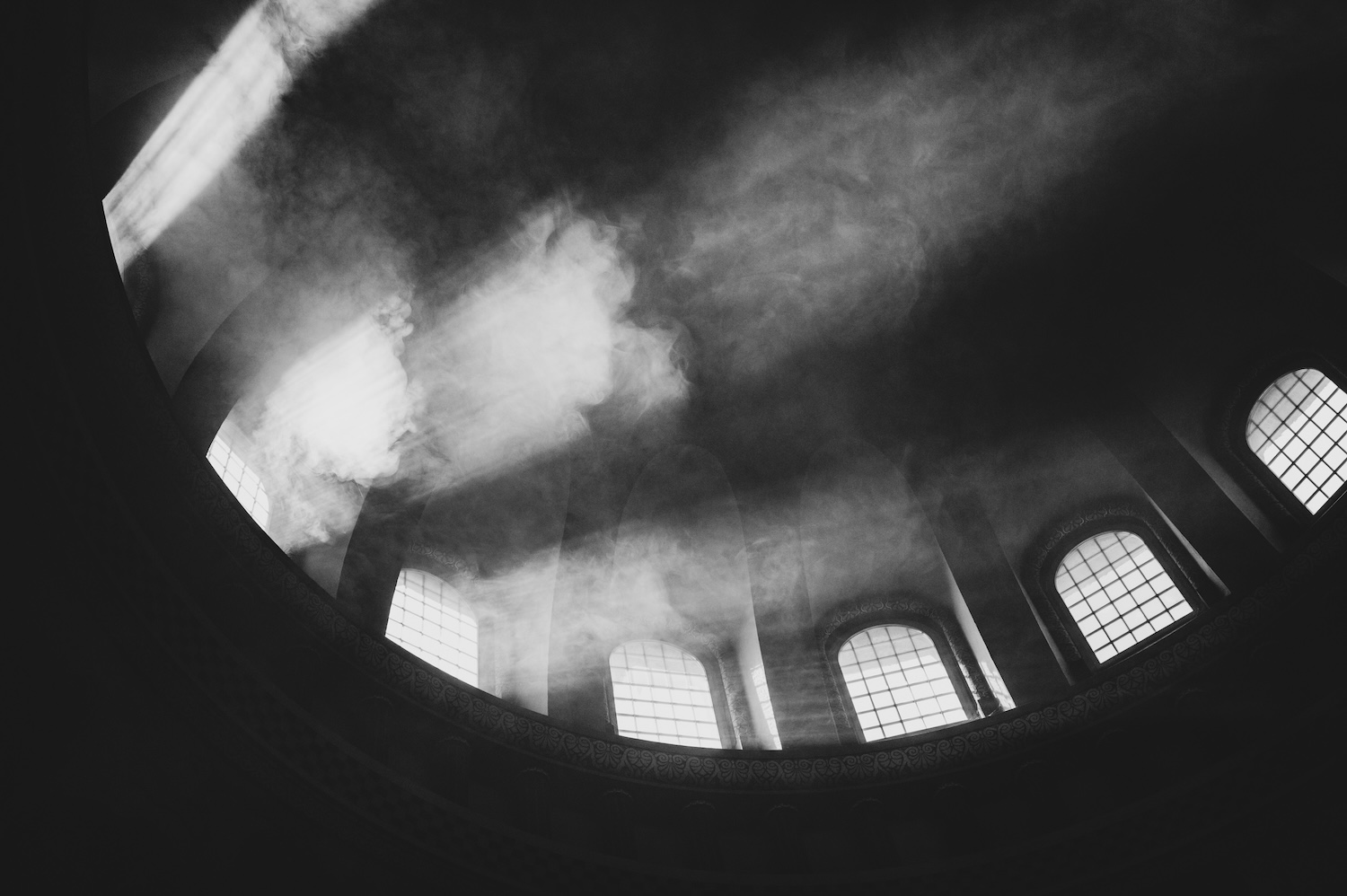
Eliane Radigue. My musical North Star.
If you get lucky in life, you get to meet a person like Raha once or twice. Such people give you riches. I am not talking about money.
With these people, doors open onto worlds you didn't know existed.
Raha Raissnia is one of those people for me. A visual artist, and one of the most inspiring presences I have known. Over the years she has introduced me to more artists, musicians, ideas, and ways of seeing than I could begin to count.
In 1993, Raha introduced me to more visual artists than I can name here. Among them was Mark Rothko — whose layered fields of color taught me something about what it means to hold a single expression long enough for it to open into pure beauty.

When I moved to New York in 1997, she introduced me to WKCR — the student radio station at Columbia University. This was before Spotify, before algorithms, before curated playlists. There was a dial, and a human being on the other end of it who knew things. Shamanic music from Korea. Cumbia from Colombia. Pygmy music from Africa. Kurdish oud. Every variety of jazz. Classical Indian music. Music from places I hadn't known to look for. And people who could talk about it — who understood what they were playing and why it mattered.
In short, WKCR changed my life.
By 2020, I was deep into gongs, and Raha and I had just reconnected after a couple of decades apart. I sent her a recording of my gong music. As always, Raha did what Raha does. She told me that my recording reminded her of a composer named Éliane Radigue.
She thought I should look her up.
I did. And I was amazed. The music I heard was exactly what I was going for with the gongs, but even deeper. This was not just music for me. It was a North Star. Something to work towards.
A Tambura for the Gongs
From the moment Raha introduced me to her work, Radigue's music became part of my daily practice. I used her recording as a tambura — a musical reference to get me in tune.
A tambura is a drone instrument used in classical Indian music. It provides a continuous tonal reference — two notes, held in tune, for the musician to hear and calibrate to. The musician tunes to it, breathes with it, finds their way inside the music through it.
Daily, since I first heard this track, I use it as a tambura for my gong work. I turn it on when I am setting up for a session — deciding how to place the gongs in the room, how to position them relative to each other, which mallets belong with which gongs. I try a mallet on a gong and listen: is it in tune with what Radigue is doing? If it is, it belongs. If it isn't, I keep looking.
It is a way of tuning — not just the instruments, but myself.
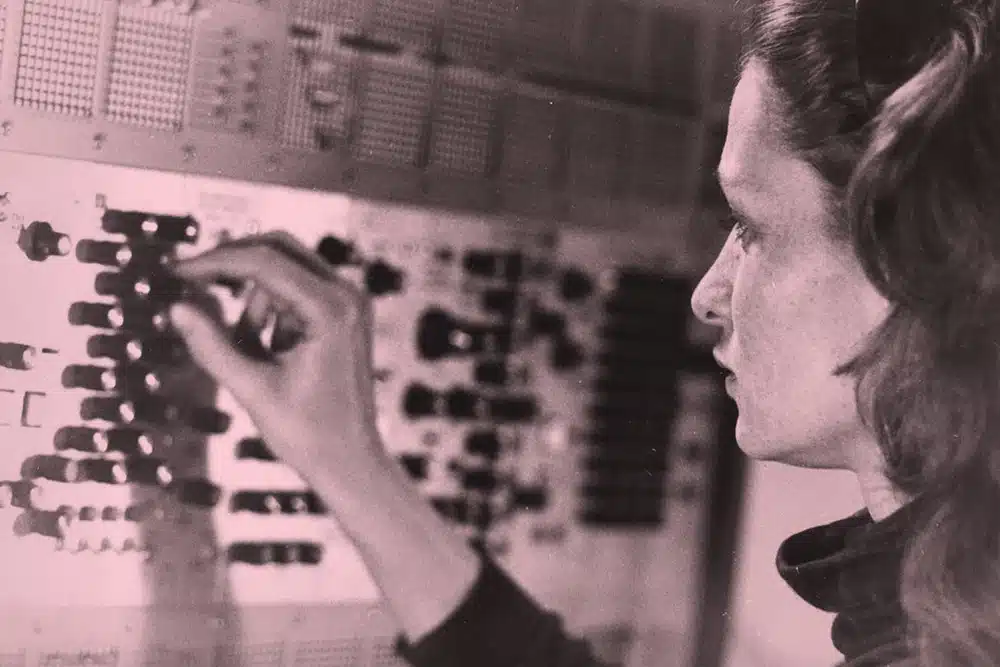
Éliane Radigue
Éliane Radigue was born in Paris in 1932. She began with classical piano training before discovering the avant-garde world of musique concrète in the 1950s through Pierre Schaeffer and Pierre Henry. She studied and worked with them in Paris, learning early tape and electroacoustic techniques — cutting, splicing, feedback processing.
In the 1970s she moved to synthesizer work, particularly the ARP 2500 modular synthesizer, and began creating the long, immersive, slowly evolving compositions that would define her legacy. In 1974 she embraced Tibetan Buddhism, and her spiritual practice deepened what was already central to her music: time, patience, and the inner life of sound.
Around 2001 she turned almost exclusively to acoustic instruments, creating the Occam series — works written for specific performers, built around subtle overtones and harmonics, each one a world of its own.
She died in Paris on February 23, 2026, at the age of 94.
The Occam Series
When Radigue died, I began researching her life more deeply. And I discovered something I hadn't known: the Occam project.
The Occam pieces are not written down. Radigue transmitted them orally — sitting with each musician, describing the music in words, passing it from her inner world directly into theirs. No score. No notation. A composition given as a gift, person to person.
When I read this, something in me ached. I wished I had known sooner. I would have written to her. I would have asked if she might give an Occam for the gongs. That possibility is gone now.
But I decided to do the next best thing I could imagine. I decided to imagine she gave me one.
Focused Bandwidth
The performance I am giving on May 31st is called Focused Bandwidth. It is a long-form gong composition — a single arc of sound, built from a deliberately narrow range of tones and overtones. No hooks. No dramatic gestures. No sonic clichés. The piece moves the way a plant grows: too slowly for the mind to track.
It is my first major work conceived as pure musical expression — composition for its own sake, after eight years of playing gongs in the service of others. It is a beginning.
And it is offered in honor of Éliane Radigue — a composer who spent a lifetime listening more deeply than almost anyone, and who showed me, without ever meeting me, what that kind of listening makes possible.
If you would like to be there, I will be performing this piece on the 31st of May in Zurich. You can RSVP here.
Alan Steinborn is a gong artist and meditation teacher based in Zürich, Switzerland. He offers gong baths, sound meditations, and contemplative experiences for individuals, corporate teams, museums, and places of worship across Zürich, Basel, and the wider Swiss German region. His practice is rooted in thirty years of meditation teaching and ten years of gong work.